
1. Overview
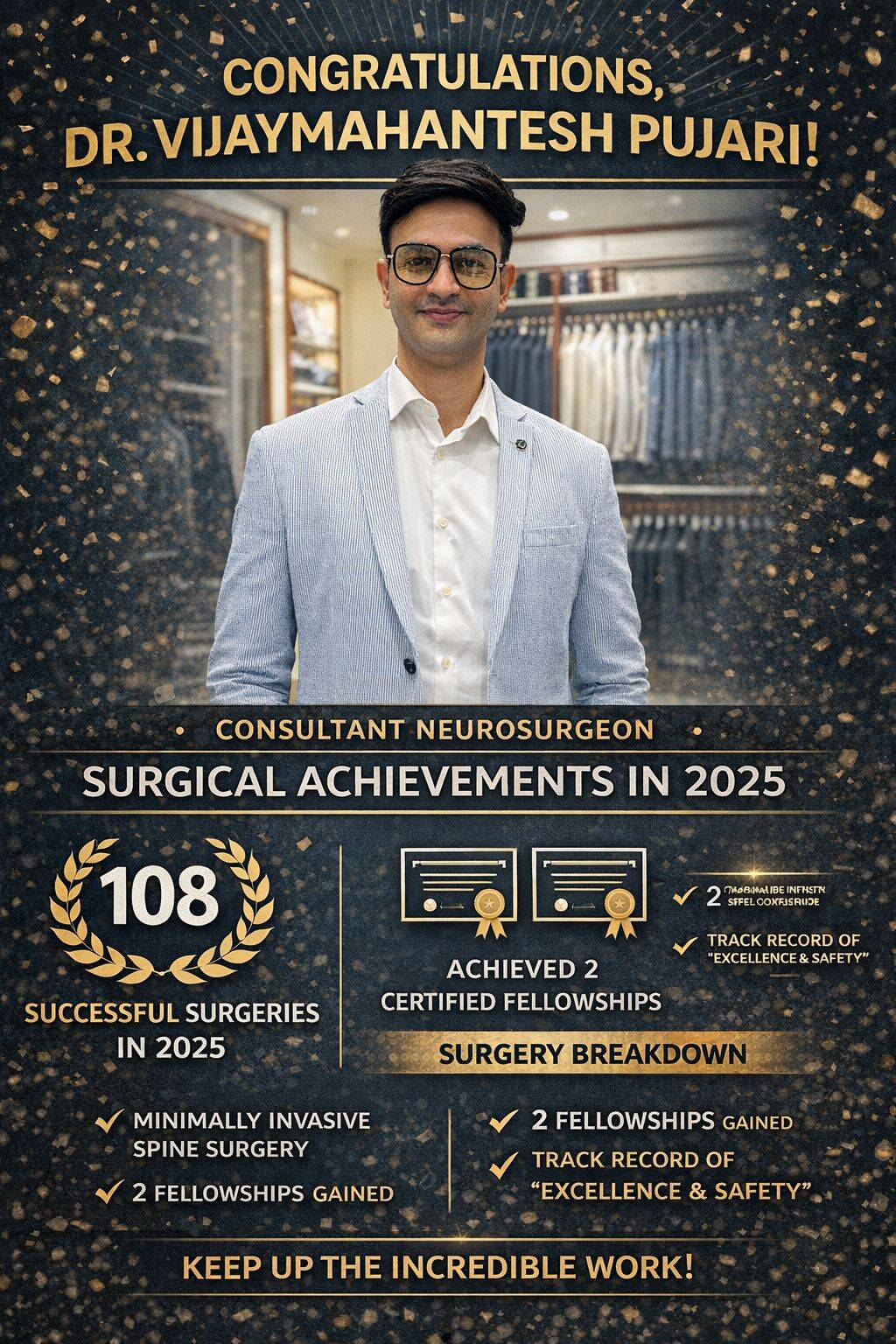
The year 2025 was a highly productive and academically significant period for the Department of Neurosurgery, functioning under the leadership of Dr. Vijaymahantesh Pujari, Consultant Neurosurgeon.
The department demonstrated consistent growth in clinical workload, surgical complexity, and adoption of advanced minimally invasive neurosurgical techniques, with a continued emphasis on patient safety, ethical practice, and optimal clinical outcomes.
2. Surgical Workload and Volume
During the calendar year 2025, a total of 108 neurosurgical procedures were successfully performed across multiple tertiary and secondary care centres.
Surgical activity remained consistent throughout the year, with peak operative volumes observed in November (18 cases) and September (16 cases).
A significant proportion of procedures were performed using minimally invasive and keyhole techniques, contributing to reduced postoperative morbidity and shorter hospital stays.
This surgical volume reflects a high-volume, consultant-led neurosurgical practice with sustained performance and service delivery throughout the year.
3. Spectrum of Surgical Procedures
The department managed a comprehensive range of cranial and spinal neurosurgical conditions, including the following:
A. Spine Surgery
Minimally invasive lumbar and cervical discectomy
Keyhole tubular decompression for spinal canal and foraminal stenosis
MISS-TLIF and spinal fixation procedures
Management of degenerative, traumatic, infective, and recurrent spinal pathologies
B. Cranial and Functional Neurosurgery
Microvascular decompression for trigeminal neuralgia
Ventriculoperitoneal shunt procedures
Craniotomy for intracranial tumors and hematomas
Tethered cord detethering procedures performed under intraoperative neuromonitoring (IONM)
4. Use of Advanced Technology
Throughout 2025, neurosurgical procedures were performed using state-of-the-art technology, including:
Keyhole and minimally invasive spine surgery (MISS) techniques
Operating microscope
Intraoperative neuromonitoring (IONM)
Advanced imaging modalities and precision surgical instrumentation
The use of these technologies contributed to improved surgical accuracy, reduced complication rates, and enhanced functional outcomes.
5. Clinical Outcomes and Patient Safety
The majority of patients demonstrated significant postoperative clinical improvement.
Complication rates were low and managed effectively in accordance with established clinical protocols.
Patient safety, evidence-based decision-making, and ethical clinical practice remained central to all surgical and perioperative activities.
6. Academic and Professional Development
During 2025, Dr. Vijaymahantesh Pujari successfully completed two certified fellowships, further strengthening expertise in:
Minimally invasive spine surgery
Advanced neurosurgical techniques
These academic achievements directly enhanced clinical capability, procedural scope, and quality of patient care within the department.
7. Key Achievements – 2025
108 successful neurosurgical procedures performed
Establishment of a high-volume minimally invasive spine surgery practice
Adoption and expansion of advanced keyhole neurosurgical techniques
Completion of two certified fellowships
Excellent clinical outcomes with strong patient satisfaction
8. Conclusion
The year 2025 represents a significant milestone in the neurosurgical services led by Dr. Vijaymahantesh Pujari, marked by clinical excellence, surgical innovation, and academic growth.
The Department of Neurosurgery remains committed to continued advancement in minimally invasive neurosurgery, patient-centered care, and academic contribution in the years ahead.
📍 Visit us at:
Nara Vijnana Centre
Giriraj Annexe Building, T B Road, near Court Circle,
Deshpande Nagar, Hubballi, Karnataka 580029